
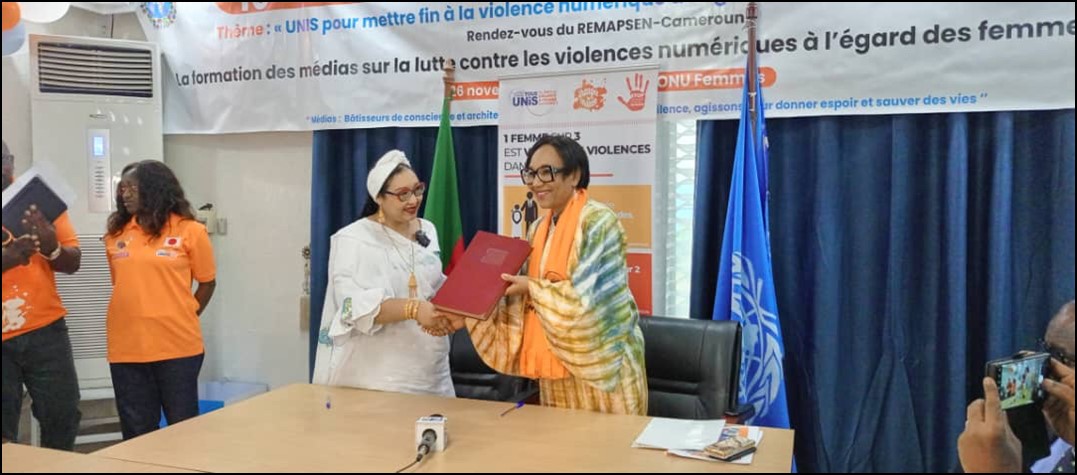
As Cameroon joins the international community to observe the 19th edition of the global campaign of “16 days of activism on violence against women and girls”, UN WOMEN, through its representative to Cameroon, Marie Pierre Raky Chaupin, has appointed Cameroonian writer and women’s rights activist, Djaïli Amadou Amal, as the UN Women Ambassador to Cameroon.
This appointment, made by the United Nations Entity for Gender Equality and the Empowerment of Women on November 26, recognises Djaïli for her decade-long fight against gender-based violence and advocacy for women’s rights through her writing and her association, Femmes du Sahel.
This happened during a press point in the UN Women conference hall during a media training on the fight against digital violence towards women and girls. The topic of the event organised by the Network of Patrons and Actors of Health Research for the Development of Africa, REMAPSEN, in partnership with UN WOMEN, under the theme, “Media: Builders of conscience and architects of change, let us break the silence, let us act to give hope and save lives.”
In a welcome speech, the Cameroon Coordinator for REMAPSEN, Prince Mpondo, expressed heartfelt gratitude, on behalf of his team, to UN Women for partnering with and supporting them in this initiative aimed at promoting health research and development in the African continent.
The UN Women’s Programme Manager in Cameroon, Joséphine Medjom, gave a background and mandate of the organisation, stating some of its functions. This includes leading and coordinating the UN’s gender equality work, supporting member states in implementing global standards, and advancing women’s empowerment in four key areas: ending violence against women, economic empowerment, women’s leadership and political participation, and peace and security. She further went ahead to explain what gender is so as to understand what gender-based violence (GBV) really is.
Gender is defined as a social construct built through cultural, political, and social norms and practices regarding what it means to be masculine or feminine. It often defines the roles, duties, and responsibilities expected of people based on the sex assigned to them at birth, not necessarily whether one identifies biologically as male, female, or non-binary. Some of these roles assigned to them are the root cause of the gender-based violence we witness today. The male child is expected not to cry or complain when hurt, on the grounds that it makes him look foolish and weak. As a result, no matter the pain he goes through, he doesn’t speak, and it keeps accumulating until one day of a single outburst, and you hear he has killed someone. Women on the other side are taught to submit to men and be endurant. They are abused, tortured, and brutalised in their relationship, but they hide their situation until they fall dead.
According to the testimony of Regine Ndjiki, President of the Association Un Geste pour Mon Prochain (AGESPRO) and Executive Secretary of the Department of Women and Social Affairs of the Council of Protestant Churches of Cameroon (CEPCA), gender-based violence is a societal reality that many people choose to suffer in silence. She narrated the story of her biological daughter who was tortured by her husband, but she chose to stay silent until her little daughter started exhibiting what she saw her dad doing. That was when she confronted her daughter, but she still chose to be silent about it. The abuse continued until they travelled abroad, and there he continued until one day the lady called 911, and the man was recuperated by the police.
Talking at the training session on how journalists can use the law to protect survivors of gender-based violence, Gabriel Nonetchoupo, Head of the Division of Promotion and Protection of Human Rights at the Cameroon Human Rights Commission (CDHC), who is involved in various initiatives aimed at promoting human rights, including the prevention of torture and the protection of vulnerable groups, listed a number of national and internationally ratified legal instruments, specific laws and conventions like the Maputo Protocol, Beijing Action Plan, and Cameroon Penal Code that fight against gender-based violence.
Digital experts took turns to explain and answer questions on what digital violence against women and girls is and its different forms, like image-based abuse, cyber harassment and bullying, hate speech and misinformation, doxing, cyberstalking and surveillance, hacking and impersonation, sextortion, threats of violence, technology-facilitated trafficking and exploitation, the consequences of these practices, and how to identify, prevent or take immediate action once it happens, given its inevitability.
A memorandum of understanding, MoU, was signed between newly-appointed UN Women Ambassador, Djaili Amadou Amal, and UN Women representative to Cameroon, Marie Claude Raky Chaupin, to crown the media training with REMAPSEN.
By Solange Tegwi
