
By Tandong Calistus Jong
Nairobi, Kenya
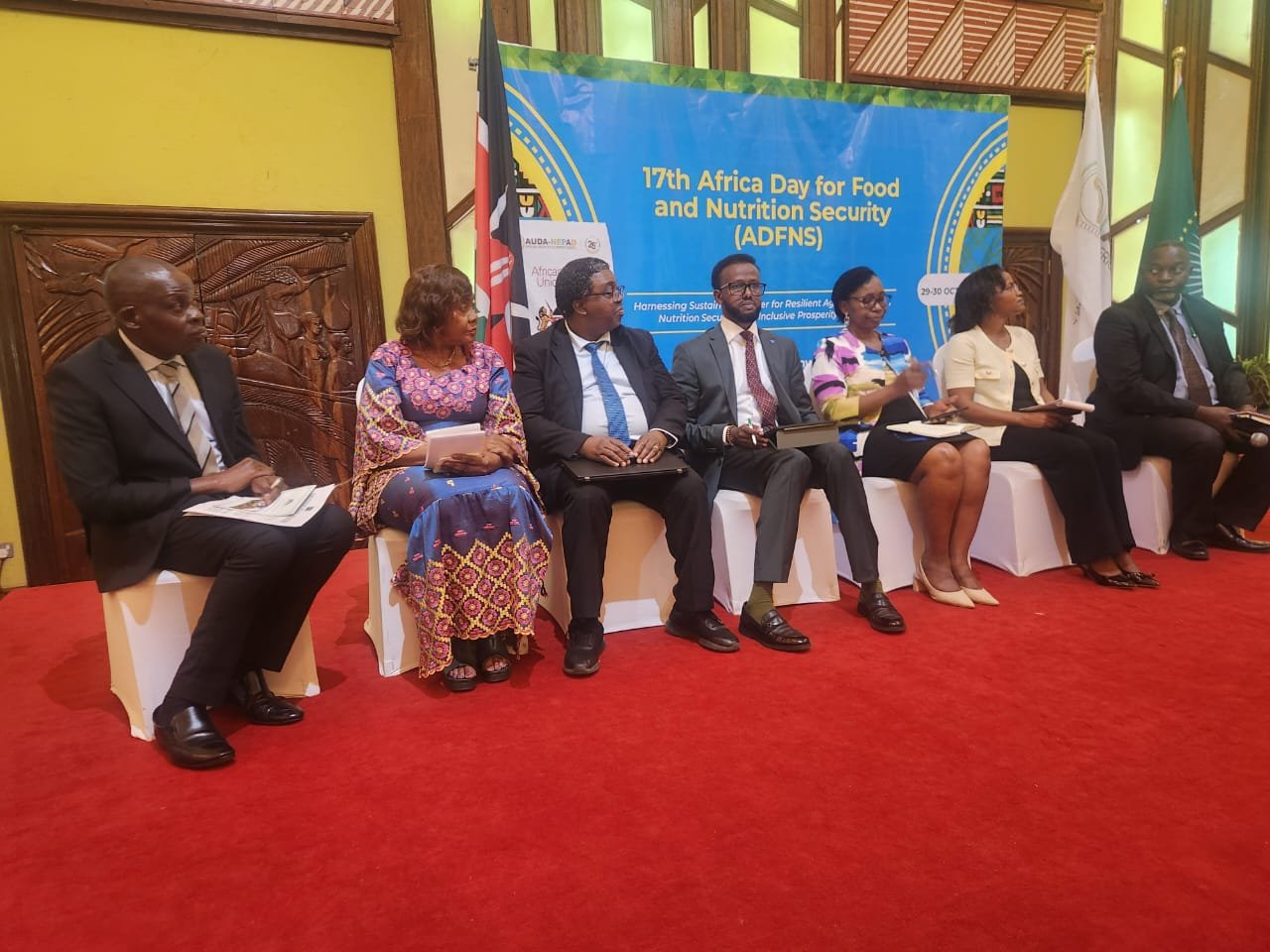
Africa’s efforts to end hunger, eliminate all forms of malnutrition and build resilient agrifood systems will depend largely on how sustainably the continent manages its water resources. This was a central message as African leaders and stakeholders gathered in Nairobi, Kenya, to commemorate the 17th edition of Africa Day for Food and Nutrition Security (ADFNS).
Held under the theme, “Harnessing Sustainable Water for Resilient Agrifood Systems, Nutrition Security and Inclusive Prosperity in Africa”, this year’s commemoration places sustainable water management at the heart of the continent’s fight against hunger and malnutrition.
The event, taking place from 29 to 30 October, is organised by the African Union Commission (AUC) and the African Union Development Agency (AUDA-NEPAD), in collaboration with the Government of Kenya.
The gathering seeks to strengthen the implementation of food and nutrition security policies, strategies and programmes, while providing a platform for stakeholders to assess persistent challenges and identify practical solutions to reducing and ultimately eliminating malnutrition across Africa.
It also features technical discussions on the Comprehensive Africa Agriculture Development Programme (CAADP) Kampala Declaration, with a focus on strengthening collective action towards improved food and nutrition security.
The African Union launched the first Africa Day for Food and Nutrition Security in Lilongwe, Malawi, on 31 October 2010. Since then, the annual commemoration has evolved into a continental platform for political dialogue, technical exchanges, advocacy, partnership building and resource mobilisation to tackle hunger and malnutrition while supporting the transformation of Africa’s food systems.
Over the years, these efforts have contributed to the implementation of the CAADP and the Malabo Declaration. However, stakeholders say renewed political commitment and stronger implementation efforts are needed to ensure that the initiative makes a greater contribution to the objectives of the CAADP Kampala Declaration.
During this year’s gathering, participants called on African countries to raise public awareness about the importance of investing in nutritious, high-value foods and agricultural commodities as part of broader efforts to improve food and nutrition security.
They also stressed the need for stronger engagement among key stakeholders, including farmers’ organisations, private-sector players, academic institutions and research bodies. Such collaboration, they argued, would help develop practical strategies and national action plans to end hunger and malnutrition.
The importance of sharing successful experiences and innovative approaches was equally emphasised, particularly initiatives that empower women and strengthen food and nutrition security at community and national levels.
This year’s theme also highlights the critical role of water in transforming Africa’s agrifood systems. Beyond supporting crop production, sustainable access to water is essential for livestock farming, fisheries, aquaculture, food processing, food safety, sanitation, healthy diets, ecosystem protection and human well-being.
Yet, across the continent, water scarcity, droughts, floods, declining water quality, biodiversity loss and environmental degradation continue to threaten the productivity and resilience of agrifood systems. Growing competition for limited water resources is adding to these pressures.
The scale of Africa’s food security challenge is reflected in figures contained in the 2026 State of Food Security and Nutrition in the World (SOFI 2026) report.
According to the report, an estimated 645 million people worldwide experienced hunger in 2025, representing 7.8 per cent of the global population. This was a slight improvement from 8.1 per cent in 2024 and 8.6 per cent in 2022. However, approximately 2.1 billion people still faced moderate or severe food insecurity in 2025.
Africa continues to carry a disproportionately large share of this burden. Although the prevalence of hunger on the continent declined slightly from 20.3 per cent in 2024 to 20.0 per cent in 2025, the improvement represents only a modest break in an upward trend that had persisted since 2017.
An estimated 309 million Africans remained undernourished in 2025, making Africa the region with the highest number of people facing hunger.
The long-term trend is particularly worrying. Between 2010 and 2025, the number of people experiencing hunger in Africa rose from approximately 171 million to 309 million, nearly doubling over the period. By 2025, the continent had overtaken Asia in the absolute number of people affected by hunger.
The wider food insecurity picture is equally troubling. In 2025, approximately 56.6 per cent of Africa’s population experienced moderate or severe food insecurity. This compares with 20.3 per cent in Asia and 22.9 per cent in Latin America and the Caribbean.
The figures underline how far Africa remains from achieving Sustainable Development Goal 2 (SDG 2), which aims to end hunger, achieve food security, improve nutrition and promote sustainable agriculture by 2030.
The urgency of addressing the crisis is further reinforced by research identifying malnutrition as one of the leading causes of death and disability across the continent.
Experts and stakeholders increasingly stress that food security should not be measured simply by whether people have enough food to eat. It must also take into account access to safe, diverse, healthy, nutritious and affordable diets.
The 2026 SOFI report identifies the high cost of healthy diets as a major structural obstacle to improving nutrition globally. An estimated 2.7 billion people worldwide cannot afford a healthy diet, with the challenge particularly severe in Africa.
These realities point to the need for African governments, development partners, private-sector actors, farmers’ organisations and other stakeholders to intensify their efforts to build resilient agrifood systems, make nutritious food more affordable and address the underlying causes of hunger and malnutrition.
Ultimately, ending malnutrition in Africa will require more than political declarations. It will demand sustained political commitment, adequate investment, effective policy implementation, stronger partnerships and reliable data to guide inclusive, evidence-based interventions.
As discussions continue in Nairobi, the central message remains clear: nutrition must be treated as a development priority, with sustainable water management, resilient agrifood systems and the well-being of African people placed at the heart of the continent’s development agenda.
