
By Etienne Mainimo Mengnjo
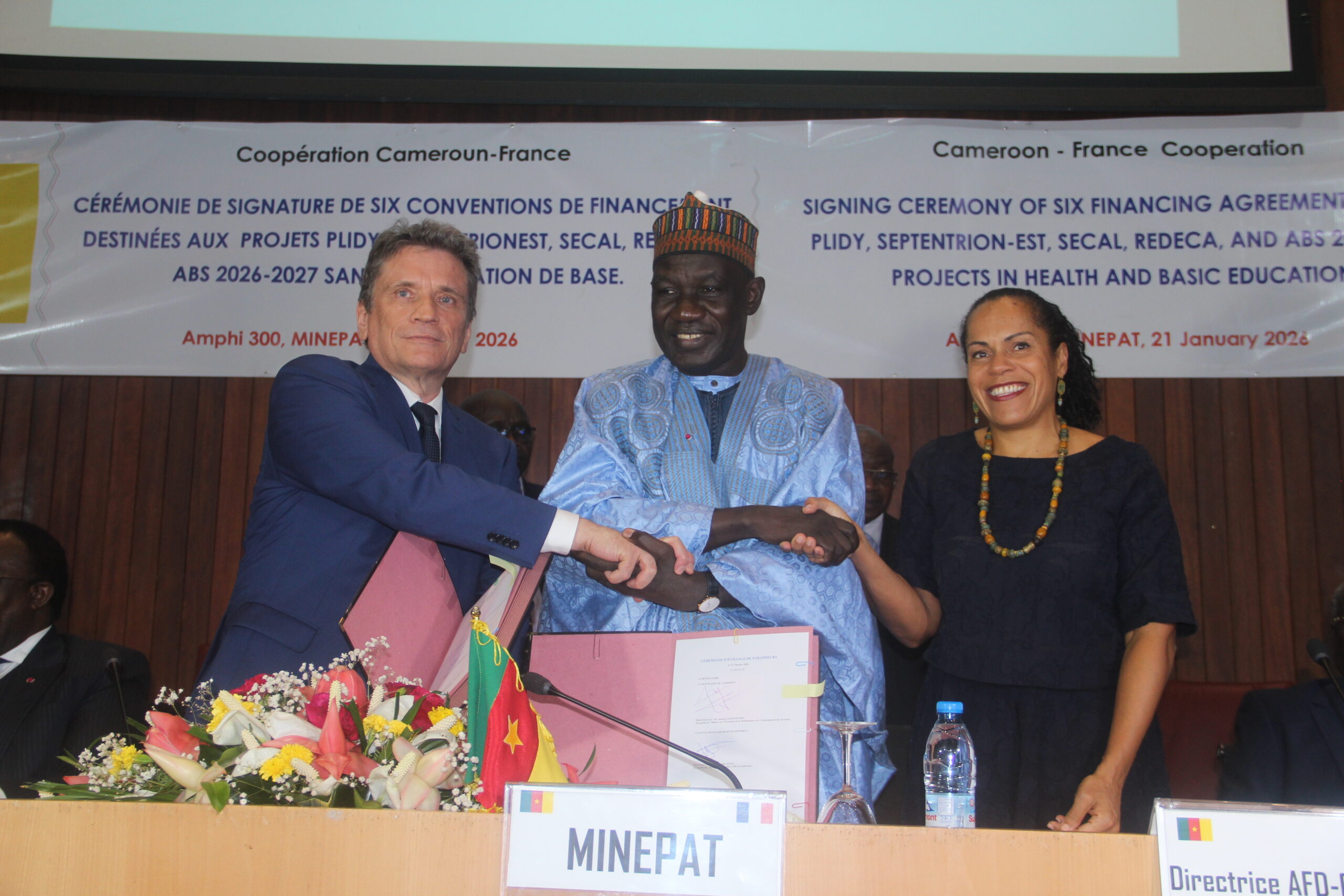
The governments of Cameroon and France have reinforced their economic partnership with the signing of a FCFA 123.3 billion financing package aimed at accelerating national development.
The agreement was finalized on January 21 in Yaounde, with Alamine Ousmane Mey, Cameroon’s Minister of Economy, Planning and Regional Development (MINEPAT), and French Ambassador to Cameroon, Sylvain Riquier, signing the documents. Virginie Dago, Director of the French Development Agency (AFD) also signed the documents in the presence of several Cameroonian cabinet Ministers.
The financing package is comprehensive, consisting of a sovereign loan, two grant agreements, and three specific allocations under the 3rd Debt Reduction and Development Contract (C2D).
Officials have indicated that these resources are tailored to tackle some of Cameroon’s most pressing issues, such as rapid urbanization, climate change risks, and the ongoing decentralization of government authority.
A major part of the agreement includes a loan of FCFA 98.4 billion dedicated to the Douala and Yaoundé Flood Control Project (PLIDY). Authorized by Presidential Decree on December 9, 2025, this financing features a 20-year repayment period and supports a comprehensive six-year investment strategy.
The program is designed to sustainably reduce the vulnerability of urban populations to flooding, bolster climate resilience, and improve the overall quality of life in the cities’ most exposed neighborhoods.
The project targets over two million residents in areas prone to frequent flooding, integrating physical infrastructure with social and technical enhancements. Planned interventions include developing and rehabilitating drainage canals and restoring natural water absorption zones.
Furthermore, the initiative aims to improve accessibility to neighborhoods and essential urban services, such as solid waste management, while enhancing the data tools necessary to monitor urban vulnerability.
In addition, two grants focused on food security and gender equality were also signed totaling FCFA 6.56 billion (10 million Euros). The first grant allocates 3.28 billion FCFA (5 million Euros) to expand the Project to Support Food Security in Rural Territories of Cameroon (SECAL), which was initiated with a funding of 16 million Euros from the 3rd C2D. The project aims to strengthen the rural business ecosystem through various support mechanisms.
In discussing the project’s expansion, Minister Ousmane Mey stated: “This additional funding will allow us to expand the project’s scope and intensify support activities, particularly through loans and the provision of small equipment.”
While initially targeting five production areas, the initiative is now extending to the Fako Division in the Southwest Region. This growth follows a successful preliminary phase, where more than 8,400 rural businesses had been identified as beneficiaries by 2024.
The second grant, also worth FCFA 3.28 billion (5 million Euros) is dedicated to the Capacity Building Project for Women Entrepreneurs in the Northern and Eastern Regions known as “Septentrion-Est.”
This initiative focuses on improving women’s access to financing, technical support, and economic integration in structurally vulnerable areas. Virginie Dago remarked that: “This project builds on a pilot phase successfully implemented in the Far North and will support women’s entrepreneurship in four target regions.”
Moreover, three additional agreements will allocate 28 million Euros, approximately FCFA 18.37 billion, from the 3rd C2D. Two of these agreements will provide budget support for the health and education sectors for the 2026-2027 periods. The health sector will receive 12.5 million Euros to enhance equitable access to essential care and reduce maternal and infant mortality, while 11 million Euros will be allocated to basic education, continuing support initiated in 2017 for school construction and teacher stability.
The 3rd agreement funds the Project to Strengthen Decentralization in Cameroon (REDECA) with 4.5 million Euros. This project aims to enhance local governance and the ability of urban communities to provide public services through improved transparency, citizen participation, and institutional capacity.
Minister Ousmane Mey stated: “This involves deepening the decentralisation process enshrined in the Constitution by providing local authorities with the necessary tools to effectively exercise their powers.” It complements other urban programs financed by C2D resources.
The remaining grant funding is designated for the Septentrion-Est project, which will support women entrepreneurs in northern and eastern Cameroon. The initiative aims to improve access to technical training and financial resources, fostering economic integration for women in fragile zones.
A significant portion of the total financing package, amounting to FCFA 18.37 billion, is earmarked for essential social services through 2027. This includes FCFA 8.2 billion for health, aimed at reducing maternal and infant mortality, and FCFA 7,216 billion for basic education, focusing on improving school construction and teacher stability. An additional CFA 2.95 billion will support the Project to Strengthen Decentralization, empowering local communities to enhance public service transparency.
Minister Mey reiterated the importance of local empowerment, declaring that the effort involves deepening the constitutional decentralization process and equipping local authorities with the tools they need to exercise their roles effectively. These projects are integral to Cameroon’s 2020-2030 National Development Strategy and support President Paul Biya’s broader vision of achieving emerging nation status by 2035.