By Nformi Sonde Kinsai
Government and UN officials have stated that the ConvergeFood Joint Programme – a whole-of-government and interagency UN initiative involving WFP, FAO, UNEP, UNIDO, and UNCDF is unique as it intends to touch some 60 percent of women and youth entrepreneurs in the project areas of the East, Adamawa, and Far North Regions.
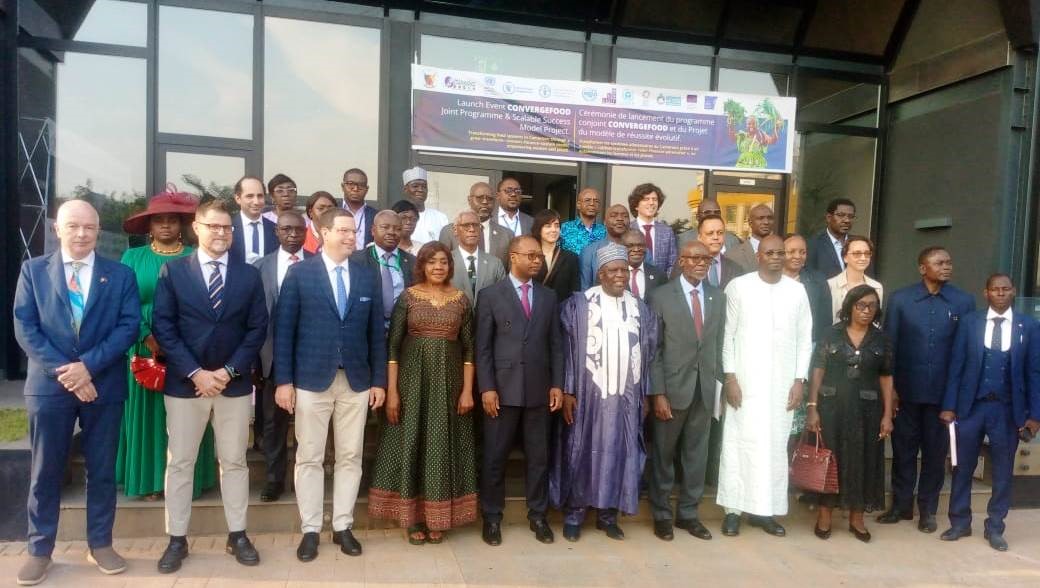
The officials who spoke in Yaounde on March 25, 2026 during the official launching of the ConvergeFood Joint Programme and the Scalable Success Model, SSM Project were unanimous that the 60% target of women and youth is in line with the prescriptions of President Paul Biya who promised during his investiture to put the concerns of the two groups at the centre of government action.
Speaking at the event, the UN Resident Coordinator, Dr. Issa Sanogo under whose leadership the programme is operating, said it aims at strengthening key food value chains and unlock blended finance to catalyse private sector investments for smallholder farmers, women and youth led cooperatives as well as agri-businesses across the above three cited regions in Cameroon.
Dr. Sanogo outlined the three strategic pillars of the programme to include rice value chain transformation which gears at increasing national production, scaling climate-smart practices, introducing digital agriculture, and expanding irrigated land. Concerning the agro-ecological production for staples and livestock, it aims at diversifying crops, promoting local seeds/breeds, and expanding renewable energy-powered production systems.
In regard to import substitution and local market activation, the UN Resident Coordinator talked of promoting “producing Cameroonian, consuming Cameroonian,” linking cooperatives to structured buyers, and reducing food import dependency. Sanogo noted that their response through ConvergeFood is based on ground reality, including the challenges of climate change being faced by the local farmers. He added that their involvement is a demonstration of the UN support to government, stating that the collective commitment of all stakeholders will lead to success.
The Minister of Agriculture and Rural Development, MINADER, Gabriel Mbairobé said about 80% of agricultural practices is being carried out by smallholder farmers in the face of challenges such as the increasing population in need of food, effects of climate change and global crises that is threatening food security. He said to stem the tides; the modernisation of agriculture must go with the provision of adequate tools and seeds that can withstand the effects of climate change.
He disclosed that in addition to the SDG Fund of US 2 million dollars for three years spanning 2026-2028 to catalyse food systems innovations in Cameroon, the Islamic Development Bank has pledged US 15 million dollars in concessional financing through the Global Flagship Initiative for Food Security to scale up the project.
He dwelled on the priority value chains in the said regions including rice intensification systems that would see technologies to reduce methane emission, promotion of aquaponics that has to do with fish and rice production, and the opening of new production areas. For cassava, it would enhance best practices of manufacturing, agro-ecological production, and improved local varieties. Eggs and dairy would see the promotion of climate-smart livestock, improving local breeds, renewable energy for production and transformation of animal products.
The Minister of Small and Medium-Sized Enterprises, Achilles Bassilekin, in presenting the presidential initiative to support cooperatives and small and medium-sized enterprises to improve revenues and employment for youth and women in rural areas expounded on key pillars and support programmes they are working on.
The Secretary of the Global Flagship Initiative on Food Security, Dr. Conrad Rein presented goals and means of the structure to support food systems in arid and semi-arid lands of Africa with Cameroon pioneering. The EU Delegation Head, H.E. Stephen Peedell spoke on supporting food systems through Scalable Success Model initiative with the case of Cameroon in point; the Spanish Ambassador, H.E. Juan Pedro Perez-Gomez talked on multi-lateral support of food systems in Cameroon; while the Secretary General in MINADER, Prof. Grace Mbong expounded on advancing the food systems pathway and the convergence action blueprint.
Meanwhile, according to WFP information sheets, expected outcomes of the programme include strengthened multi-sectoral governance; improved agro-processing infrastructure and best practices of manufacturing; widespread adoption of climate-smart and agro-ecological practices; and increased income and employment for women and youth across value chains.
The programme that equally targets the inclusion of 20% of refugees and IDPs projects that for phase one in 2026, 44 cooperatives/micro, small and medium enterprises in the chosen areas will be touched. Some 7, 014 direct beneficiaries are earmarked while strengthening financial education.
For phase two (2027-2028) some 1000 cooperatives and micro, small and medium enterprises will be supported, US 15 million dollars pledged to scale up and 500 000 direct beneficiaries including 120 000 school children are earmarked.