
The rapid growth of artificial intelligence, AI, is increasingly intensifying and reinforcing violence perpetrated against women and girls online worldwide. Like all forms of online violence, coercive controls, surveillance harassment, deep fake, the anonymity of perpetrators impedes full access to justice for victims, while inadequate laws and regulatory framework uphold a culture of impunity for perpetrators.
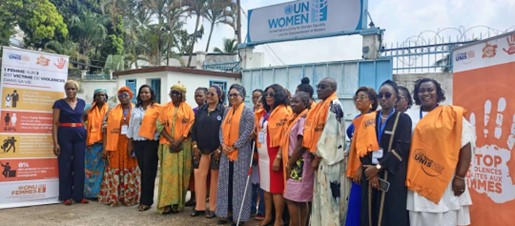
UN Women representative and participants at end of the digital literacy strengthening workshop.
In order therefore to increase women and girls protection against this scourge and to create an environment where all women and girls can enjoy their rights and fully explore the advantages of digital platforms in all safety, the UN Women thought it important to harmonise the knowledge of all actors to better surpervise female users in secured online interventions knowing that multi-sector competence of all actors is indispensable for the prevention, or follow up of survivors.
A capacity-building workshop for stakeholders on digital literacy, focusing on digital security and rights, particularly for adolescents and marginalized groups, was organized at the UN Women headquarters in Yaounde on December 12.
The event that was officiated by UN Women Resident Representative to Cameroon, H.E. Marie Claude Raky Chaupin was part of the closing activities of the “16days All Unite to End Violence against Women and Girls” campaign. The strengthening digital literacy workshop was done by the President of the Cameroon Association of Female Lawyers, ACAFEJ, Magistrate Yvonne Leopoldine Akoa.
The legal expert made the participants, who comprised youths engaged in civil society and media personnel, clearly understand that the digital world is a dangerous terrain to be treaded on with absolute caution. She presented the different risks associated with sharing private sensitive information with an individual or group through various social media platforms like WhatsApp, Messenger, Facebook, and TikTok.
She also went ahead to give measures to be taken in case one falls victim, which most often is almost inevitable. She equally outlined different legal instruments and bodies to direct complaints to, and how to behave towards survivors of online violence.
Magistrate Yvonne Akoa, who also doubles as the Vice President of the Court of Appeal of the Centre Region, using live examples, detailedly explained different acts people pose in private but become detrimental to their personality once they leak to the public. The major one is the taking and sharing of nude pictures and videos. Avoid taking naked pictures that expose your private body parts, no matter how appealing they are, the jurist hammered.
You could lose attention in a twinkle of an eye, be it in the office, home, or even church, and someone picks up your phone, forwards the images knowingly or unknowingly to the public. Note, she continued, sometimes, even if technology experts succeed in deleting the images, someone more experienced can still retrieve them. Prevention, she warned, is better than cure.
Given that missteps and mishaps cannot always be avoided with the use of digital technology, she highlighted the national and regional legal framework that protect people who fall victim; the African Charter on the Rights and Welfare of the Child encompasses girls, the Maputo Protocol officially the Protocol to the African Charter on Human and Peoples’ Rights on the Rights of Women in Africa.
She also listed national institutions like the law enforcement officers, the Ministry of Post and Telecommunications (MINPOSTE), the Telecommunications Regulatory Agency (ART), and the National Agency for Information and Communication Technologies (ANTIC). Families and communities must also be empathetic towards members who are survivors of online violence and not put them in a tight corner where they can consider ending their lives, she pointed.
Closing the workshop, the UN Women representative acknowledged the Cameroonian authorities for the leadership in promoting gender equality and women empowerment, through the Ministry of Women’s Empowerment and the Family, MINPROFF, under Prof Marie Therese Abena Ondoua. She also thanked all actors, media personnel, and youths engaged in civil society for their involvement and engagement during the entire campaign.
By Solange Tegwi.

