
By Andrew Nsoseka
A Cameroonian environmentalist has restored forests, revived groundwater and created more than 300 jobs in her home region by blending Japanese forest restoration techniques with grassroots community mobilization.
Limbi Blessing Tata, founder of Ecological Balance Cameroon, says her work in Nkambe in the Northwest Region was inspired by a simple childhood observation: as forests receded, streams disappeared with them.
“Growing up, we depended on nature for everything,” Tata recalls. “If you were sick, you knew where to find medicine. If you were hungry, you knew your farm. But as the forests moved further away, the streams also moved. There was clearly a link.”
In Nkambe, many homes still lack running water. Families rely on public taps or untreated streams. To secure water for an 8 a.m. engagement, residents often arrive at taps by 4 a.m. During the peak dry season, some walk nearly a kilometer to find what Tata describes as “clean” water — “clean in quotes”.
After university, Tata entered the conservation field but found herself caught between two opposing schools of thought: development advocates willing to sacrifice forests for infrastructure, and strict conservationists who argued that nature should be left entirely untouched.
“I was not comfortable with either side,” she says. “We cannot separate conservation from livelihood. That’s not my reality.”
Her conviction deepened after a dangerous encounter with illegal loggers while working to protect Microberlinia bisulcata, known locally as zebra wood and described by forestry officials as “the cocaine of the forest” because of its high international value. The experience convinced her that enforcement alone would not save forests.
“Conservation cannot work if people do not have better livelihood options,” she says. “Everybody involved in illegal logging is protecting their income.”
In 2016, as a new single mother with no steady income, Tata resigned from her job and registered Ecological Balance Cameroon. Armed with a laptop and an internet stick, she began writing grant proposals — sometimes 15 a week — often working 18-hour days.
Her breakthrough came with a £5,000 grant from the Rufford Foundation. “For us, £5,000 was like a miracle,” she says. “It was validation that this could work.”
The turning point in her approach came during a 2018 scholarship in Kerala, India, where she encountered the Miyawaki method, pioneered by Japanese botanist Akira Miyawaki. The dense native planting technique boasts survival rates of up to 82 per cent and, crucially, can recharge groundwater up to 30 times more effectively than monoculture plantations.
“I realized that our untouched primary forests in Cameroon were already like Miyawaki forests — native, diverse, dense,” Tata explains. “The method simply replicates intentionally what nature does over time.”
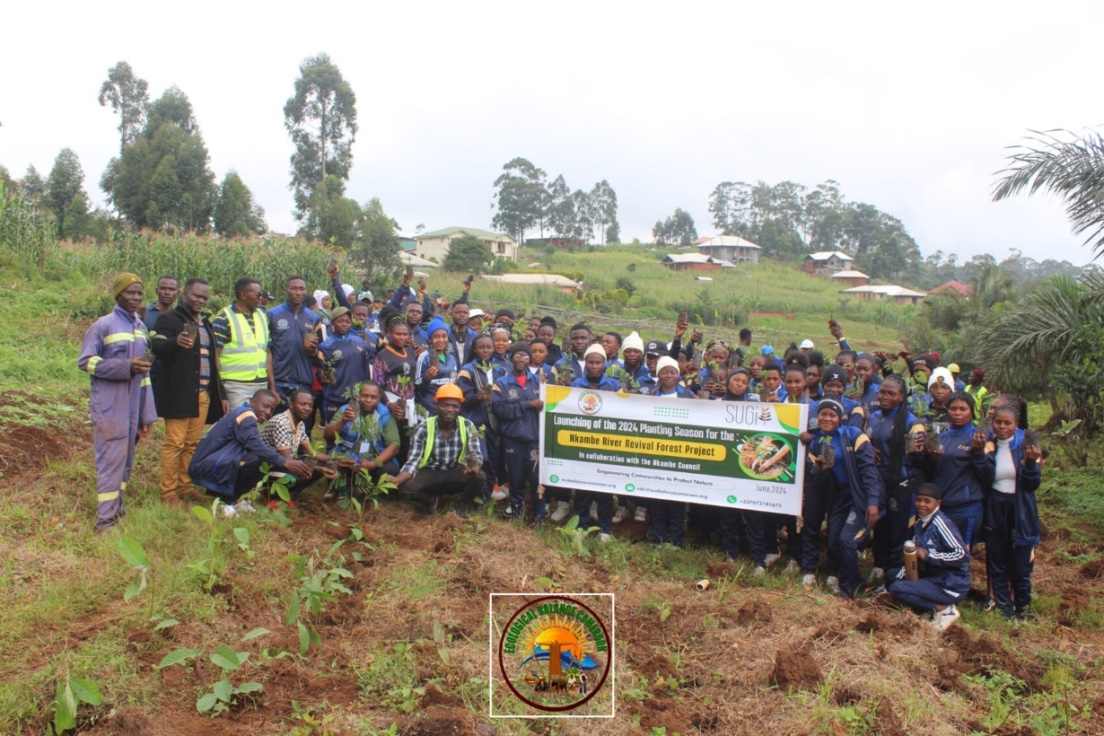
Her first Miyawaki forest, planted in 2019, covered just 200 square meters and included 600 trees. Today, the organization has established nine such forests, five funded by SUGi, including the flagship Nkambe River Revival Forest Project.
Convincing communities to protect watersheds proved challenging. Farmers cultivating vegetables in wetlands during the dry season were reluctant to surrender fertile land. In some cases, newly planted trees were uprooted.
“We had to work closely with traditional councils and chiefs,” Tata says. “We don’t just talk about trees. We talk about groundwater availability. Even if you build taps, if there’s no water in the aquifer, nothing will flow.”
She often invites elderly residents to describe how rivers have shrunk to a fraction of their 1980 levels, framing conservation as a matter of memory and survival rather than abstract environmentalism.
Within two years of the first plantings, local water management committees reported a noticeable rise in storage tank levels. One community was able to extend piping to a new neighborhood for the first time in decades.
The second forest became what Tata calls a “bird heaven”, with a surge in birdlife signaling ecological recovery. “Birds are like the spies of the environment,” she says. “When they come back, you know something is right.”
Since November 2023, the project has generated over 300 jobs, both permanent and part-time, through 13 community nurseries. Roles range from seed collection and nursery management to honey harvesting and sustainable packaging enterprises designed to reduce plastic pollution. Seven small businesses have been incubated so far.
Tree planting days have evolved into community celebrations, drawing chiefs, civil servants and even passing soldiers. Volunteers transport saplings by vehicle and on foot, while children collect discarded poly bags for recycling.
Yet Tata warns that relying solely on grants is unsustainable. During the COVID-19 pandemic, pledged funding vanished overnight. She now plans to diversify income streams through cooperative social enterprises, carbon and water credits, and payments for ecosystem services.
Over the next five years, she hopes to scale restoration across all five agroecological zones of the Northwest Region, building what she calls “thriving communities, not surviving communities”.
However, she acknowledges the need for stronger scientific backing. “We need data,” she says. “We can say the water has increased, but we must prove it. Science is not based on emotions.”
For Tata, the lesson is clear: conservation must be practical, community-driven and anchored in purpose.
“Beyond grit and resilience, your work must be bigger than yourself,” she reflects. “That is what makes an organization outlive its founder.”