
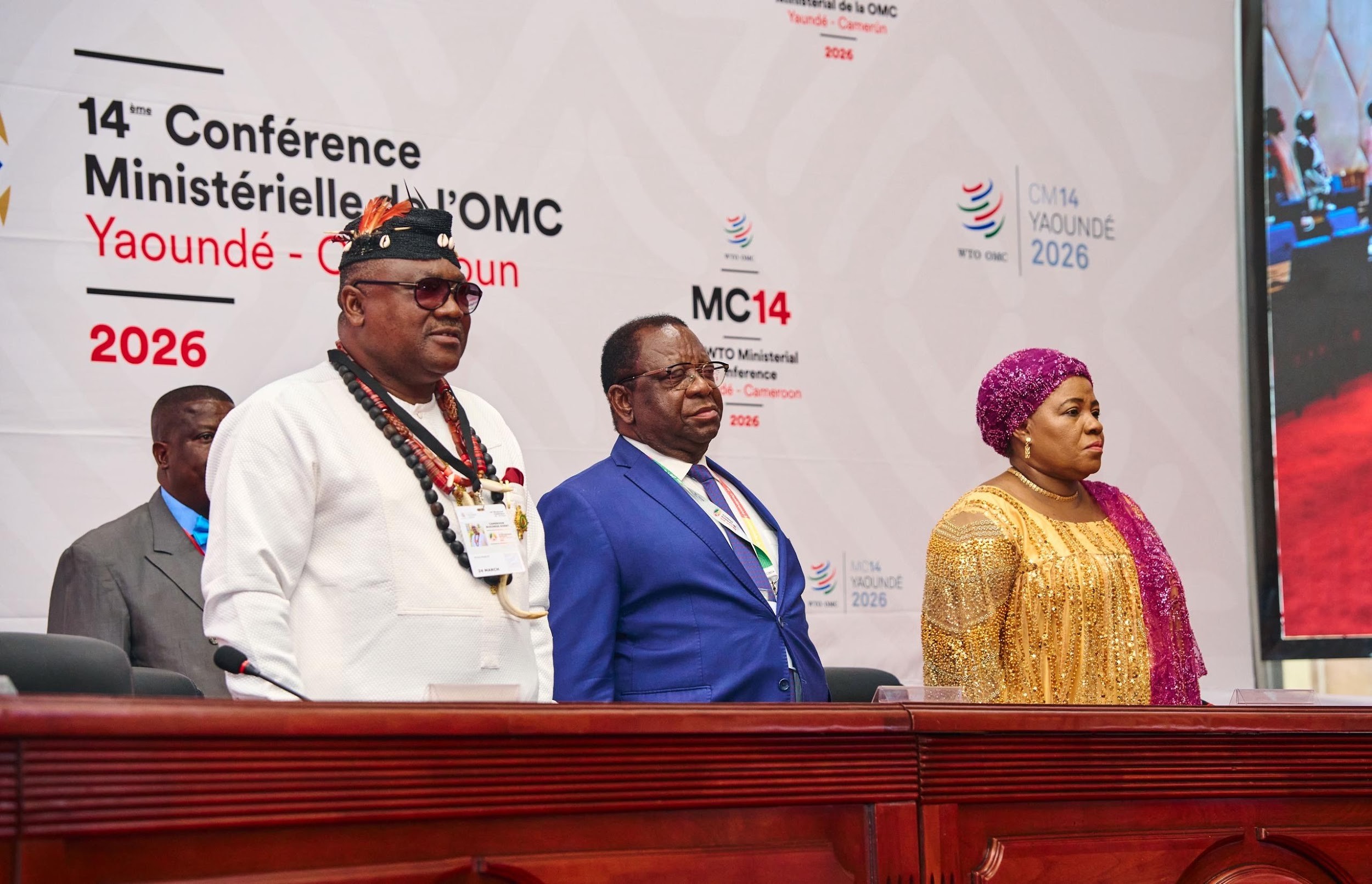
Access Bank on March 24 convened a high-level private sector forum in Yaoundé on the sidelines of the 14th Ministerial Conference of the World Trade Organization (MC14), bringing together key actors to chart a new course for Africa’s trade future.
Held under the theme “Formalising informal trade and expanding trade corridors for visible and sustainable change,” the forum assembled senior government officials, financial institutions, development partners, private sector leaders, entrepreneurs, and trade experts at a critical moment for both global and continental trade.
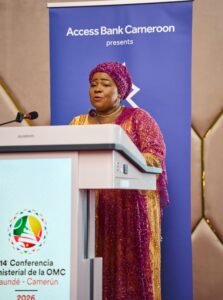
The event, attended by H.E. Luc Magloire Mbarga Atangana, Cameroon’s Minister of Trade and Chairman of WTO MC14, was officially opened by Mrs. Patience Melone, Chairperson of Access Bank Cameroon PLC.
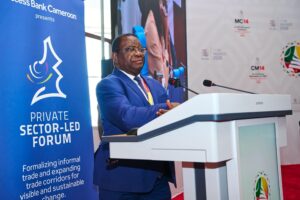
Speaking at the forum, Minister Atangana underscored the urgency of repositioning Africa within the global trade system.
“Africa’s growth depends on our ability to formalize trade, strengthen regional value chains, and enable businesses to compete across borders,” he stated, emphasizing that public-private collaboration remains central to advancing trade facilitation, industrial development, and inclusive economic transformation.
At the heart of the forum was a strong message delivered by Mrs. Patience Melone, who set the tone for the day’s discussions by highlighting a fundamental challenge facing African economies.
While trade is deeply embedded in African societies, she noted, much of it remains informal—limiting its ability to significantly contribute to GDP growth, job creation, and improved living standards.
“Most Africans have a generational trading tradition, but it remains largely informal,” she said, challenging stakeholders to rethink how trade is structured across the continent.
She further questioned how Africa can extend its trade corridors and create visible change while many traders—particularly women—continue to operate in survival conditions with limited opportunities for growth.
Her message was clear: the private sector must take a leading role, as no economy can grow without it.
This perspective aligned with broader concerns raised during the forum, particularly the structural imbalance in global trade participation. Despite accounting for about 16 percent of the world’s population, Africa contributes only around 2.9 percent to international trade.
Yet, the continent’s potential remains significant. With a population exceeding 1.3 billion people and projected to reach 2.5 billion by 2050, Africa represents one of the largest emerging markets globally—one that must be strategically organized to benefit its own economies.
Panel Discussions
During the first panel discussion, which focused on transitioning informal businesses into the formal economy, Chief Nfon Ekoko Mukete IV, 1st Vice President of the Cameroon Chamber of Commerce, Industry, Mines and Handicrafts, explained that informality persists because it is simple and predictable.
Businesses, he noted, operate where they perceive value. If formal systems introduce complexity without clear benefits, traders will naturally remain informal. He called for simplified procedures, improved access to information, and stronger digital systems to encourage transition.
From a policy implementation perspective, Mr. Ewusi Mbongo Eric, representative of the Small and Medium-Sized Enterprises Promotion Agency (APME), highlighted that SMEs account for a significant portion of Cameroon’s economy, with the majority operating informally. While government has introduced guarantee funds and support programs, trust gaps between financial institutions and SMEs continue to hinder progress.
On the operational side, Mr. Guy Moutounka, representative of Safe Trade, emphasized that trade growth depends on practical enablers such as financing and logistics. Through platforms like WeGoAfrica, supported by AGL and financial partners including Access Bank, efforts are being made to reduce the cost and complexity of cross-border trade for SMEs.
The discussion also explored the opportunities presented by the African Continental Free Trade Area (AfCFTA), widely regarded as a major driver of intra-African trade. However, stakeholders emphasized that its success will depend on practical implementation and the removal of persistent barriers.
Mr. Michael Ndoping, Director General of the National Cocoa and Coffee Board (ONCC), pointed to challenges such as currency fragmentation and restrictions on movement, which continue to limit trade integration across Africa.
Financing and Structural Challenges
The second panel shifted focus to financing, examining why capital often fails to reach SMEs despite its availability.
From the International Finance Corporation (IFC), Mr. Francis Mafeni, Investment Officer in the Financial Institutions Group, described the issue as a structural gap rather than a liquidity problem.
Across Africa, SME financing remains low, with loans-to-GDP ratios around 14 percent. He attributed this to perceived risk, weak credit data systems, and regulatory challenges that make it difficult for banks to assess and support small businesses.
Efforts are underway to address these constraints, including the development of credit bureaus, capacity-building programs, and fintech-driven financial inclusion initiatives.
From a continental perspective, Mr. Leonelle Nomechi, Manager of Structured Trade and Commodity Finance at Afreximbank, emphasized that bridging the financing gap requires practical, partnership-driven approaches. By working with local banks and supporting value chains, Afreximbank continues to strengthen industrial capacity while improving SME access to finance.
Meanwhile, Mr. Joseph Henri Ikori, representative of the Bank of Central African States (BEAC), clarified that regulatory frameworks do not necessarily limit SME financing, but that the absence of proper documentation, accounting systems, and financial records remains a major obstacle.
Payments and the Future of Trade
The forum concluded with a fireside chat featuring , DARIO ROSLIN BETNKEU
Country Director, Business Development, Mastercardwhich brought the conversation into the critical area of payments infrastructure.
The discussion emphasized that without efficient, secure, and interoperable payment systems, the full benefits of intra-African trade cannot be realized. For many small businesses, cross-border transactions remain costly, slow, and uncertain.
Strengthening digital payment systems, expanding financial inclusion, and enabling seamless cross-border settlements were highlighted as essential steps toward unlocking Africa’s trade potential under emerging frameworks.
As the forum closed, one message stood out clearly: Africa’s challenge is no longer about vision, but execution.
By convening diverse stakeholders at a pivotal moment for global trade, Access Bank has positioned itself as a strategic enabler of dialogue, investment, and innovation—supporting Africa’s transition toward a more integrated, competitive, and inclusive trade landscape.
The path forward is clear: from informal survival to structured growth, from fragmented markets to connected trade corridors, and from untapped potential to measurable economic impact.