
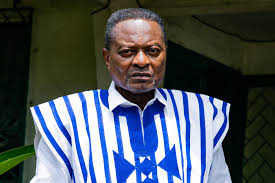
By Etienne Mainimo Mengnjo
The death of prominent opposition figure Ekane Anicent Georges, who died in military detention in December last year, has officially been attributed to natural causes, according to a recent press release from the Ministry of Defense.
The statement cites a “complete absence of traumatic injuries” and points to “serious underlying medical conditions” as the cause of death of the 74-year-old political leader, who died on December 1, 2025, at the Military Centre of the National Gendarmerie in Yaoundé.
Ekane was President of the African Movement for the New Independence and Democracy (MANIDEM) and a key figure in the Union for Change coalition during the last presidential election. His death came nearly two months after his arrest in Douala in late October, in what many observers described as part of a broader crackdown on opposition members following the disputed 2025 presidential poll.
According to the Ministry, a panel of medical experts including a professor and two doctors, carried out the post-mortem examination. The report, the government said, was intended to dispel rumors and mounting speculation of foul play. Officials described Ekane as a patient with a “delicate medical history” who succumbed to pre-existing health problems rather than external violence.
However, the official account has been met with considerable skepticism. Family members had earlier raised concerns about Ekane’s health while in custody, alleging that a vital respiratory device had been confiscated — claims authorities consistently denied. The nearly three-month delay in releasing the autopsy findings further fuelled public distrust and calls for greater transparency.
For 85 days, Ekane’s body remained under judicial seal at the Yaoundé Central Hospital mortuary to allow for investigative procedures, including the autopsy. The legal impasse ended on 23 February when the State Counsel authorized the removal of the seal, enabling the transfer of his remains to his family for burial and bringing a measure of closure to a tense and emotional period.
Ekane’s detention and death sparked strong reactions across Cameroon’s political and civil society landscape. Minister of Communication and Government Spokesperson René Emmanuel Sadi offered a notably candid response, describing Ekane as a “friend” and expressing personal regret over the circumstances surrounding his arrest.
In an interview, Sadi suggested that the decision to detain the MANIDEM leader may not have involved full consultation among relevant state authorities. “There are some decisions which are taken by people who think that it is in the interest of the country. Sometimes they do not consult those who can have a different position,” he said. “I think we should regret what happened. If I was there, I would not have allowed that. It’s my own point of view.”
Legal and human rights figures also condemned the circumstances of Ekane’s death. Akere Muna described it as “a wound upon a wound”, criticizing authorities for failing to release a gravely ill detainee. Human rights lawyer Alice Nkom labelled the episode a “criminal national disgrace”, accusing the state of denying him essential medical support. Christopher Fomunyoh of the National Democratic Institute highlighted international concern, particularly as Ekane had been detained after challenging election results many Cameroonians viewed as questionable.
A veteran of the 1990s democratic movement, Ekane devoted his life to promoting multiparty politics and challenging authoritarian governance. Supporters recall that even in his final weeks, while battling serious illness, he remained resolute. An earlier erroneous report of his death had already prompted urgent appeals for his release — appeals that went unanswered.
The Ministry of Defense maintains that a formal investigation into the circumstances of his death is ongoing. For many supporters and civil society groups, however, Ekane’s passing has become a symbol of the broader struggle for accountability and transparency in Cameroon’s political system.
