
By Hope Nda
A new doctoral thesis defended at the University of Buea has underlined how negative news reports about democratic institutions fueled distrust in Cameroon’s 2025 electoral process and contributed to voter apathy.
The thesis, titled, “The Influence of Bad News Reports on Voter Apathy in Cameroon,” was defended on April 18 by Dr Mesumbe Neville Ndiwang, a young scholar from the Journalism and Mass Communication Department. It was supervised by the acclaimed Professor of journalism and communication science, Kingsley Ngange.
Using a mixed-methods approach, the study surveyed 1,626 Cameroonians across six regions and interviewed six news editors.
Its key finding was that there is a positive correlation between bad news reports and voter apathy. An increase in bad news about the electoral process leads to a decrease in voter turnout.
Dr. Mesumbe said the study was informed by a rising tide of voter apathy in Cameroon, judging from successive presidential elections.
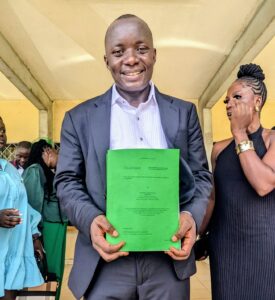
Dr Mesumbe Neville Ndiwang
For the record, official data shows voter turnout at the October 12 election stood at just 57.76 percent—representing 4,668,446 voters out of 8,082,692 registered.
“From 1997 right up to the 2018 presidential election there has been a rise in voter apathy,” he said, describing it as a cankerworm to any democratic society.
He recommended that journalists sensitise the public on the need to vote and the consequence of abstaining, and focus on a silver-lining approach to news reporting.
“The research has been able to identify the link between voter apathy and bad news reports. So journalists have a great role to play in order to promote the people to go to the polls,” he said.
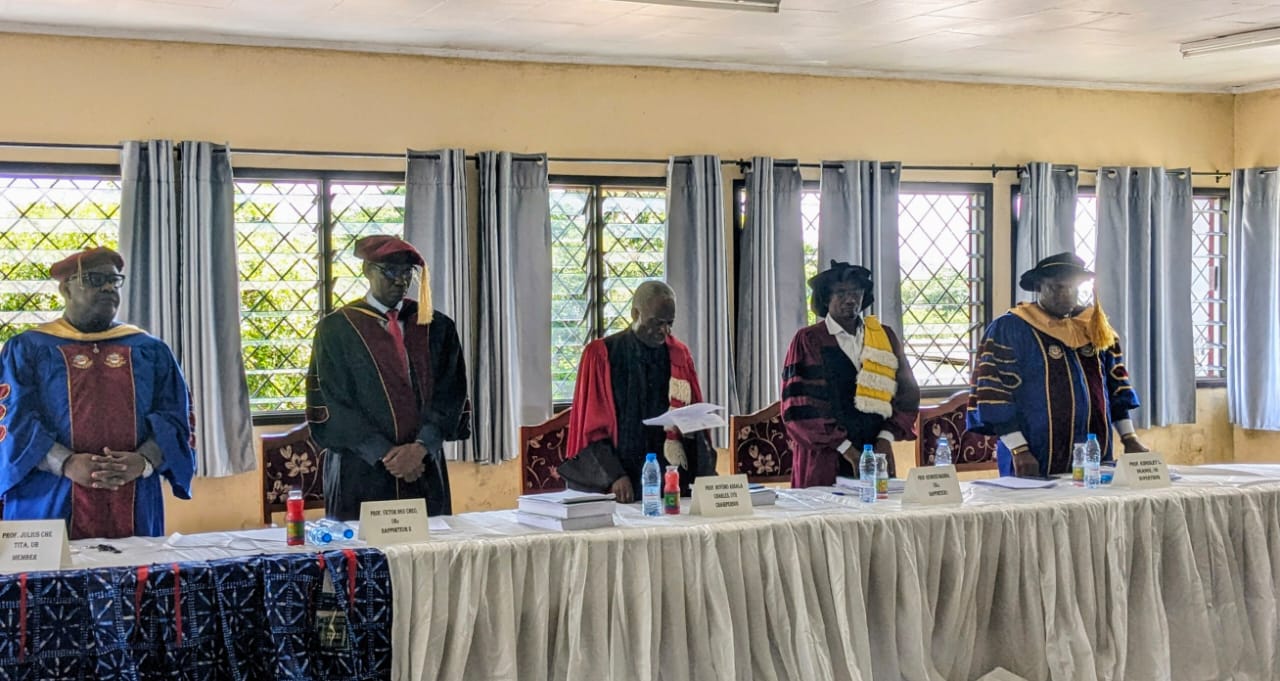
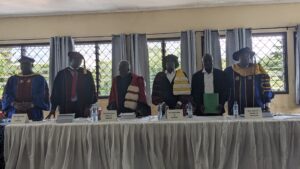
The defence jury was chaired by Senator and Emeritus Professor Boyomo Charles Asala. Other members included Prof Georges Madiba (Rapporteur I), Prof Victor Cheo (Rapporteur II), and Prof Julius Che Tita (Member), with Prof Ngange as supervisor.
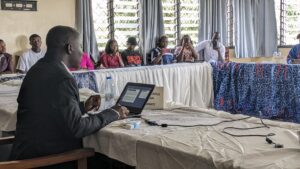
In his intervention, Prof Madiba was concerned whether journalism can survive without reporting bad news, which is generally seen as the lifeblood of the profession.
Professor Cheo sought clarification on the concept of bad news and its difference from negative or sad news, but recommended that the researcher use “bad news” to describe the impact of news on political participation as established by the study.
Professor Che Tita grilled the candidate on the qualitative approach (interview) used for the study, questioning issues of transferability, credibility and how the work can be generalised.
The Chair, Prof Boyomo, said the candidate was “too reserved, too humble” and not critical enough in his analysis of concepts like “bad news” and “voter.” He nevertheless agreed with the other jury members that the candidate was “a good researcher” before announcing a score of 87/100.
Speaking after the defence, Prof Ngange situated the theoretical and philosophical relevance of the thesis. Theoretically, he said the work attempted to examine the influence media theories such as framing and agenda-setting had on voter apathy.
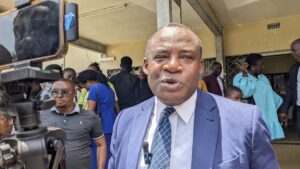
Supervisor, Prof Kingsley Ngange
Philosophically, the study applied critical realism to explain the realities of bad news influence on voter apathy, as seen in the 2025 election.
Professor Ngange agreed with the candidate that the media cannot stop reporting bad news because it is the “lifeblood of journalism.”
On the way forward, he advised: “There should be a balance in that it is not only bad news that we have in Cameroon, but there are other aspects that positive-oriented people will use to build their good judgement about Cameroon… So this work is the meeting point of responsible journalism—we advocated for social responsibility of journalists and political participation. That way, we will overcome voter apathy.”
Describing the candidate, Prof Ngange hailed Dr. Mesumbe’s “exemplary humility, perseverance, persistence and respect.” He said the work was “very relevant and timely” and that the candidate was “worthy in character to be admitted into the college of Doctors of Philosophy.”
Dr. Mesumbe Neville completed his BSc in Journalism and Mass Communication at the University of Buea in 2018, a master’s in 2020, and enrolled immediately into the PhD programme.
He has published several research articles alongside his academic mentors such as Prof Kingsley Ngange and Dr Stephen Ndode in world-renowned journals.
He is now a graduate teaching assistant lecturer in the department. Reflecting on his academic journey, he said: “There were times that we felt as if we should give up but thank God that we were being encouraged by our supervisor and other lecturers in the department. That encouragement kept propelling us to the next level.”
Present for his defence were lecturers, colleagues, friends, mentees and close relatives from his native Bakossi tribe in Kupe Manenguba Division, Southwest.
