
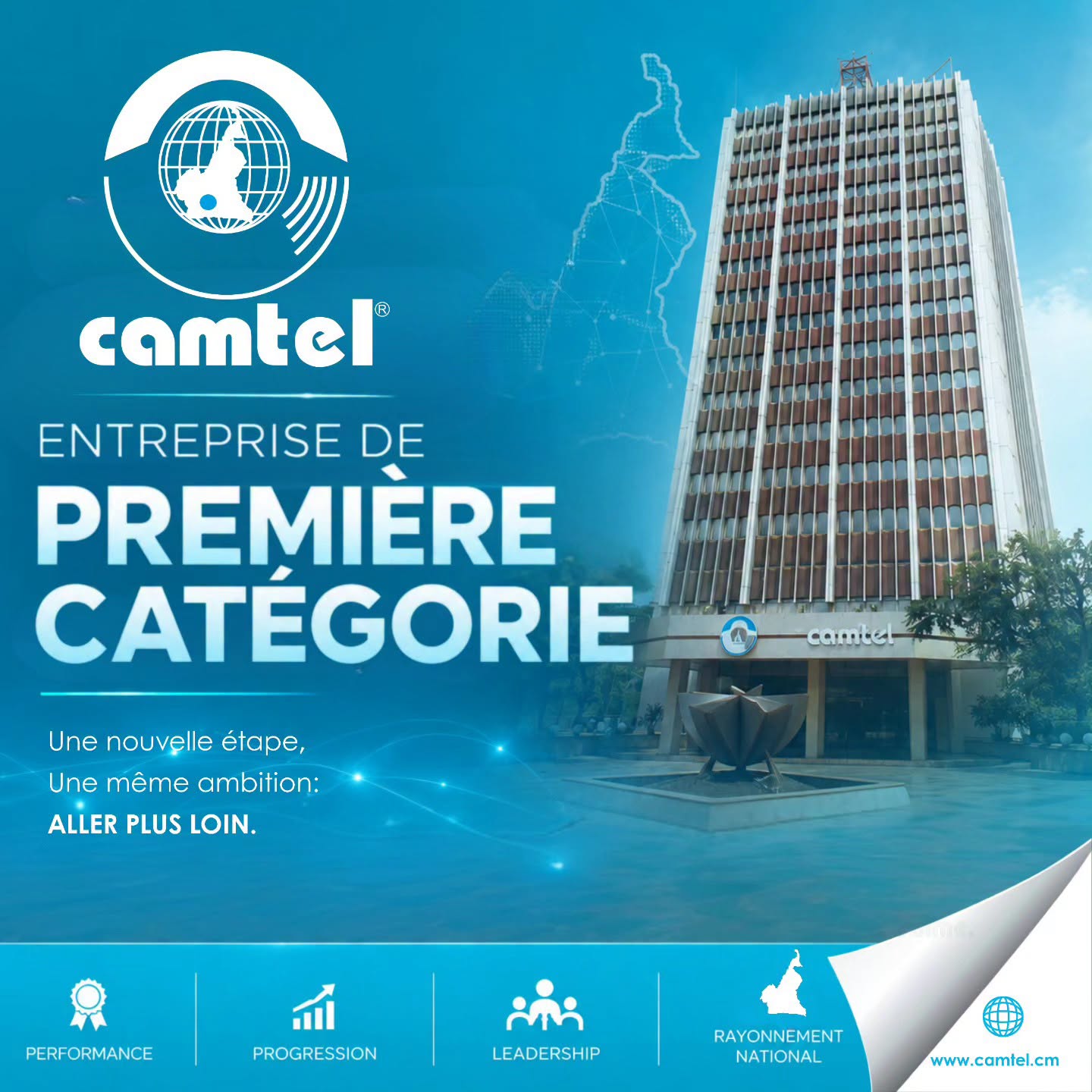
Cameroon Telecommunications (CAMTEL) has solidified its position among the nation’s premier public institutions following a performance assessment released by the Ministry of Finance (MINFI).
Signed by Finance Minister, Louis Paul Motaze on August 13 under Decision No. 00000015/MINFI, the updated classification evaluated 34 state corporations based on their performance across the 2022, 2023, and 2024 financial years.
Updated every three years pursuant to Decree No. 2019/321, this five-tier ranking system categorises state-owned entities primarily by turnover, financial profitability, and regulatory criteria, with Category 1 reserved for top-performing giants generating average annual revenues above FCFA 100 billion.
Leading the elite Category 1 cluster alongside six other major enterprises, CAMTEL demonstrated robust financial momentum by generating FCFA 177.9 billion in turnover in 2023, representing a remarkable 17.79 percent increase year-over-year.
Joining CAMTEL in this top tier are industrial and infrastructure heavyweights including the National Hydrocarbons Corporation (SNH), SODECOTON, SONARA, the Cameroon Aluminum Company (ALUCAM), the Autonomous Port of Douala (PAD), and the newly integrated Cameroon Electricity Company (SOCADEL).
The top tier reflects notable shifts in the public corporate landscape. The Autonomous Port of Douala completed a steady ascent, rising from Category 3 in May 2020 to Category 2 in 2023, and finally claiming its spot in Category 1 after posting FCFA 114.19 billion in turnover in 2024.
SOCADEL—formerly known as ENEO until its state takeover in May 2026—made its debut straight into the highest category. Conversely, ALUCAM maintained its top-tier status despite experiencing a 10 percent revenue contraction from FCFA 105.3 billion in 2023 to FCFA 94.4 billion in 2024.
Across the remaining tiers, the National Electricity Transmission Company (SONATREL) stands alone in Category 2, which covers enterprises earning between FCFA 50 and 100 billion. Category 3, representing revenues between FCFA 10 and 50 billion, encompasses seven companies led by national carrier Camair-Co, which successfully climbed up from Category 4. Lower down the spectrum, Category 4 contains three entities generating between FCFA 5 and 10 billion, while Category 5 holds 16 smaller corporations with revenues of FCFA 5 billion or less.
The latest evaluation also marked the exit or reclassification of several prominent entities. Long-troubled textile manufacturer CICAM was removed entirely from the roster due to ongoing financial distress.
Meanwhile, the Cameroon Mortgage Credit Bank and a public debt collection agency were excluded from the standard framework. As Minister Motaze highlighted, these financial institutions are now governed by specialised banking sector regulations regarding executive compensation, reflecting an evolving governance strategy for Cameroon’s state enterprise portfolio.
By Etienne Mainimo Mengnjo
