
For decades, Cameroon’s southern regions have enjoyed relatively better access to electricity, while the north has struggled with unreliable supply. Across the border in Chad, many neighbourhoods in N’Djamena have depended on noisy and expensive diesel generators. That disparity could soon begin to narrow, with more than 540,000 people expected to gain new or improved electricity services from the Cameroon-Chad Electricity Networks Interconnection Project.
The project, financed by the World Bank, African Development Bank (AfDB), European Union and Islamic Development Bank, involves the construction of a 1,556-kilometre high-voltage transmission network linking the two countries. Cameroon’s National Electricity Transmission Company, SONATREL, describes it as a major step towards regional energy integration and the creation of a Central African power market.
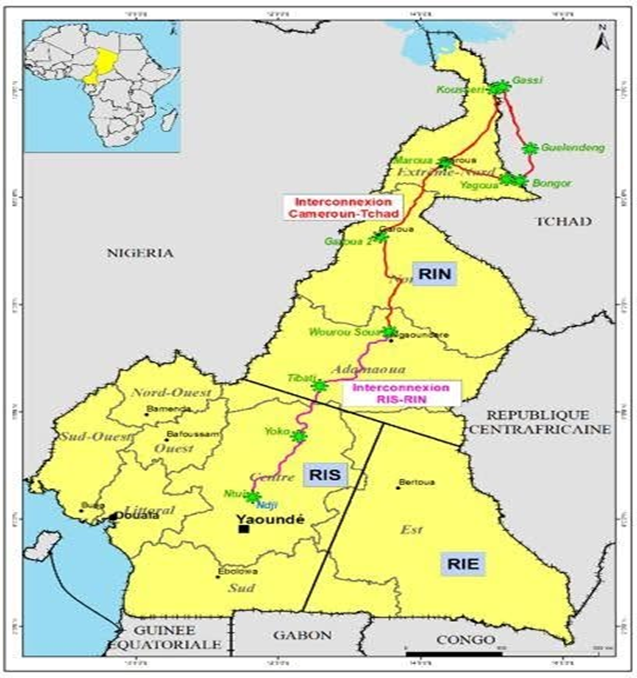
A 532-kilometre, 225kV transmission line will connect a new substation in Ntui to Wouro Soua in Ngaoundéré through Yoko and Tibati. Four new substations will support the network.
Once operational, the line is expected to transmit about 522,000 MWh annually from Cameroon’s southern grid to the northern regions, improving electricity supply in Adamawa, North and Far North. The project is also expected to encourage investment in areas where unreliable power has discouraged businesses.
A second 1,024-kilometre network will extend electricity towards Chad, including 566 kilometres in Cameroon and 238 kilometres in Chad. Three new substations will be built at Gassi, Guelendeng and Bongor. Chad is expected to import about 438,000 MWh annually, reducing its reliance on costly diesel generation.
In N’Djamena, the project will rehabilitate and extend the electricity network, install 100,000 new meters and reduce technical losses from 36 per cent to 15 per cent.
Beyond the major urban centres, 478 rural communities, 409 in Cameroon and 69 in Chad are expected to be connected to the grid.
The project also includes three initiatives aimed at economically empowering women and girls, with a target of 19.3 per cent of new household connections being headed by women.
Overall, 540,000 people are expected to benefit from improved or new electricity services.
The project is being implemented by SONATREL in Cameroon and Société Nationale d’Électricité (SNE) in Chad, under the supervision of a Ministerial Steering Committee and Joint Technical Committee.
The total project cost is estimated at FCFA 557.7 billion. The World Bank will provide FCFA 231.7 billion, the AfDB FCFA 169.2 billion and the Islamic Development Bank FCFA 80.7 billion. The EU will contribute FCFA 19.7 billion, while Cameroon will provide FCFA 52.6 billion, alongside Chad’s contribution.
Construction is expected to proceed in phases. The project ultimately aims to integrate the two countries’ power grids, enabling Cameroon to export up to 100MW to Chad while helping lay the foundation for a regional electricity market.
By Yerima Kini Nsom
