
A PhD study has challenged a key assumption of the demographic dividend theory, finding that high levels of family dependency in Africa may actually encourage people to save more rather than less.
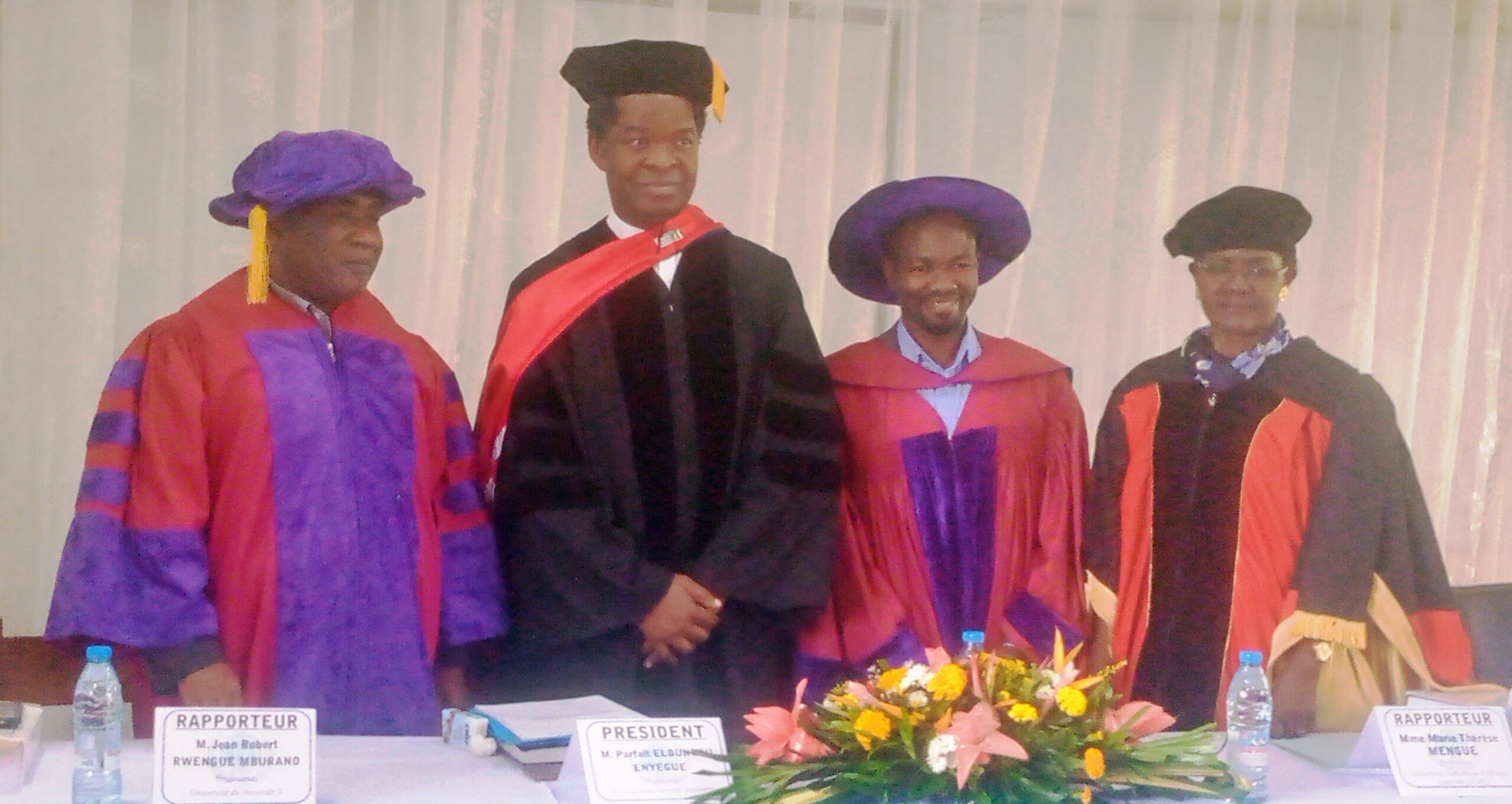
Dr. Mbarga (3rd from right) in group photo with some members of jury
The finding emerged from a thesis defended on August 11, at the IFORD campus in Ngoa-Ekelle, Yaounde, by Claude Aurélien Mbarga Ella. Titled, “Demographic Dividend and Economic and Social Development in the Socio-Cultural Context of Africa, with Cameroon as Case Study,” the study examined how demographic patterns influence economic and social development in African societies.
Mbarga was awarded a grade of Très Honorable, with the jury’s congratulations.
The jury was chaired by Prof. Parfait Martial Eloundou Enyegue of Cornell University, USA. Other members included Prof. Jean Robert Mburano of University of Yaounde II, Prof. Marie Thérèse Mengue of the Catholic University of Central Africa, UCAC, Sarah Giroux of Cornell University and the candidate’s supervisor, Dr. Gervais Beninguisse of the University of Yaounde II.
According to conventional demographic dividend theory, lower dependency levels allow individuals to save more because they have fewer dependents to support. Mbarga’s research, however, suggests that the African experience is different.
“What surprised me most is the fact that, unlike in the Western World where demographic dependency is low, in the African context, greater demographic dependency strangely encourage people to save more,” he told reporters after his defence.
He explained that family responsibilities in Africa are often distributed among members of the extended family and wider community, meaning that the burden does not necessarily fall entirely on one individual.
“The mechanism of absorbing dependency in the African context is different,” Mbarga said. “The burden of demographic dependence is shared at nuclear and extended family levels, as well as within the community.”
The study therefore questions whether demographic dividend models developed largely from Western experiences can be applied directly to African societies.
Using Endom Council in the Centre Region as a case study, Mbarga also examined how demographic dividend principles could inform local development planning, particularly by addressing rural exodus and making better use of the available labour force.
He called on policy makers to rethink development strategies based solely on individual economic gains and consider how surplus labour could be mobilised to strengthen local economies.
Professor Eloundou said the research came at an important time, as policymakers seek to translate demographic dividend theory into practical development strategies.
He described the study’s major contribution as its recognition that the individualistic model underlying much of demographic dividend theory may not fully reflect African societies, where strong family and community ties remain central to social and economic life.
By Nformi Sonde Kinsai

