
A Cameroonian-based Civil Society Organisation (CSO) Association des Femmes Engagées pour le Développement du Cameroun (AFEDEC) has submitted a significant contribution to government’s draft bill for technical review to the Cultural, Social and Family Affairs Committee of the National Assembly, currently working on the revision of the public policy relating to the condition of women in Cameroon.
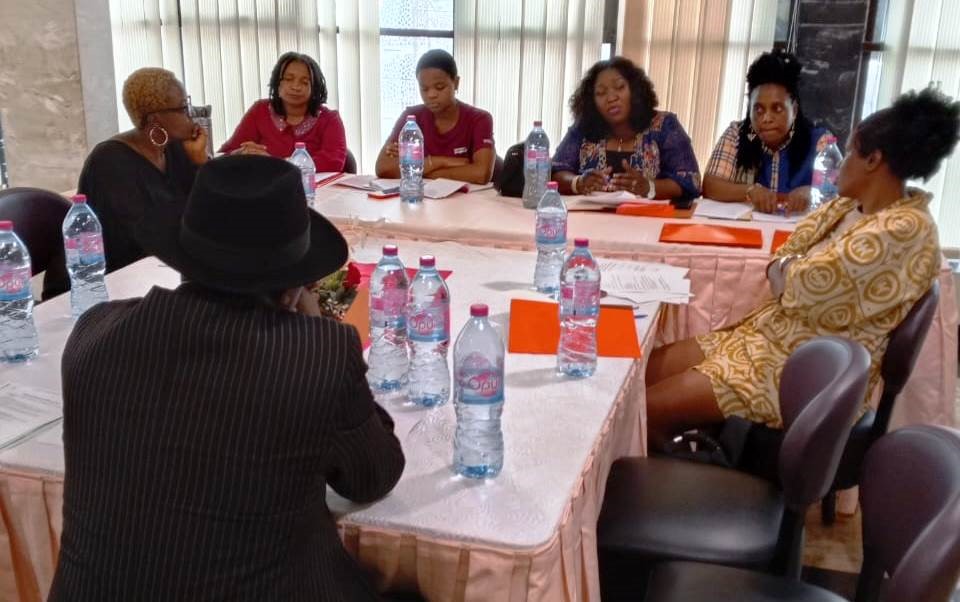
Cross section AFEDEC and other CSO leaders at one of their working sessions
Prompted by the rising cases of femicide in the country, the Committee that is working in collaboration with the Ministry of Women Empowerment and the Family, MINPROFF, at the end of their June 20, 2025, forum saw MINPROFF calling on Cameroonian CSOs to submit proposals that could be considered and incorporated in the law under revision.
It is against this backdrop that AFEDEC, headed by its President, Nadege Mapigoue, in collaboration with some nine CSOs, came out with and submitted their proposal to strengthen government’s draft bill after three long months of intense work as their own contribution. The CSOs representatives, amongst others, included: Women’s International League for Peace and Freedom – Cameroon Section (WILPF Cameroon); Women in Alternative Action (WAA Cameroon); Reach Out Cameroon; Stop Femicide 237; International Federation of Women Lawyers – Cameroon Section; and FIDA Cameroon.
AFEDEC – led proposal on: “Amending and supplementing certain provisions of the Penal Code and related Legislation on the Prevention, Investigation and Punishment of Femicide and Gender-Based Violence in Cameroon,” also submitted to MINPROFF; covers a wide range of issues.
In an explanatory statement, the proposal acknowledges the fact that violence against women and girls remains a major challenge affecting human dignity, equality, family stability and social development. It notes that while Cameroon’s legal framework provides sanctions for various forms of violence, including homicide, assault, sexual violence and other offences, the specific circumstances surrounding gender-motivated killings of women and girls require strengthened recognition and response.
“Femicide represents the extreme manifestation of gender-based violence. It often occurs within a context of previous violence, discrimination, domination, coercive control, threats, harassment or other forms of abuse directed against women because of their gender,” the proposal notes.
It states that the purpose of the proposed draft bill is therefore to strengthen Cameroon’s legal and institutional response to recognising femicide within the national legal framework; investigation and prosecution mechanisms; taking into account patterns of gender-based violence preceding killings; improving prevention measures; strengthening protection of survivors and families of victims; and improving data collection and accountability. The CSOs maintain that the envisaged reform would be implemented in harmony with the constitution of Cameroon, existing criminal legislation, and Cameroon’s international and regional commitments relating to human rights and the protection of women and girls.
After talking about the purpose of the law and scope under general provisions, the proposed document goes ahead to define key concepts such as gender-based violence, femicide, domestic violence, and survivors. And under the recognition and punishment of femicide, article 4 of their proposal states that the intentional killing of a woman or girl occurring within circumstances demonstrating gender-based motivation should be recognised as femicide. Meanwhile, Article 5 on the relationship with existing criminal offence holds that the provisions relating to femicide should apply without prejudice to existing provisions governing intentional homicide and other offences under the Penal Code.
On the assessment of gender-based circumstances as stipulated in Article 6 of the proposed bill, it is stated that in determining whether an intentional killing constitutes femicide, competent authorities should consider all relevant circumstances, including previous acts of violence committed against the victim; threats, intimidation, or harassment directed at the victim; and a history of domestic or intimate partner violence.
Other circumstances for consideration should be violence committed during separation, divorce, or attempted separation; sexual violence preceding the killing; attempts to control the victim’s autonomy, movements, relationships, or decisions; and evidence of discrimination, hatred, or contempt based on gender.
In what is termed aggravating circumstances under Article 7 of the proposal, the Civil Society leaders say such acts should be applicable where the victim was a child, was pregnant, and had previously reported threats of violence. In addition, it should apply where the perpetrator was a current or former spouse, or intimate partner; had previously committed violence against the victim; abused a position of authority, trust, or dependency; and above all, if the act was committed with exceptional cruelty.
Concerning article 8 on judicial consideration, the courts should take into account the circumstances surrounding the offence, including its patterns, when determining appropriate penalties. Meanwhile, article 9, touching on investigation and judicial response, the authorities should ensure that cases involving suspected femicide or serious gender-based violence receive appropriate attention. They should include preservation of evidence; examination of previous violence; protection of witnesses; respect for victims and families; and avoidance of discriminatory practices.
The proposal from its article 10 upward highlights aspects of training of justice and security personnel; protection and support measures, notably access to support services and support for families of femicide victims in its articles 11 and 12, respectively. Other areas detailed by the proposal is on prevention and national coordination; data collection and monitoring, reporting, as well as the role of partners and CSOs.
Meanwhile, according to information contained in the report of the June 2025 forum, 57 cases of femicide were recorded in 2022, 66 in 2023, 76 in 2024, and over 30 in the first five months of 2025. Within the first four months of 2026, over 50 cases were officially recorded, while since 2023, at least 219 women and girls have been killed in gender-related violence in Cameroon.
By Nformi Sonde Kinsai

